Starting August 1, 2025, the first requirements of the EU AI Act for generative artificial intelligence will take effect. What does this mean for developers, users, and content creators?
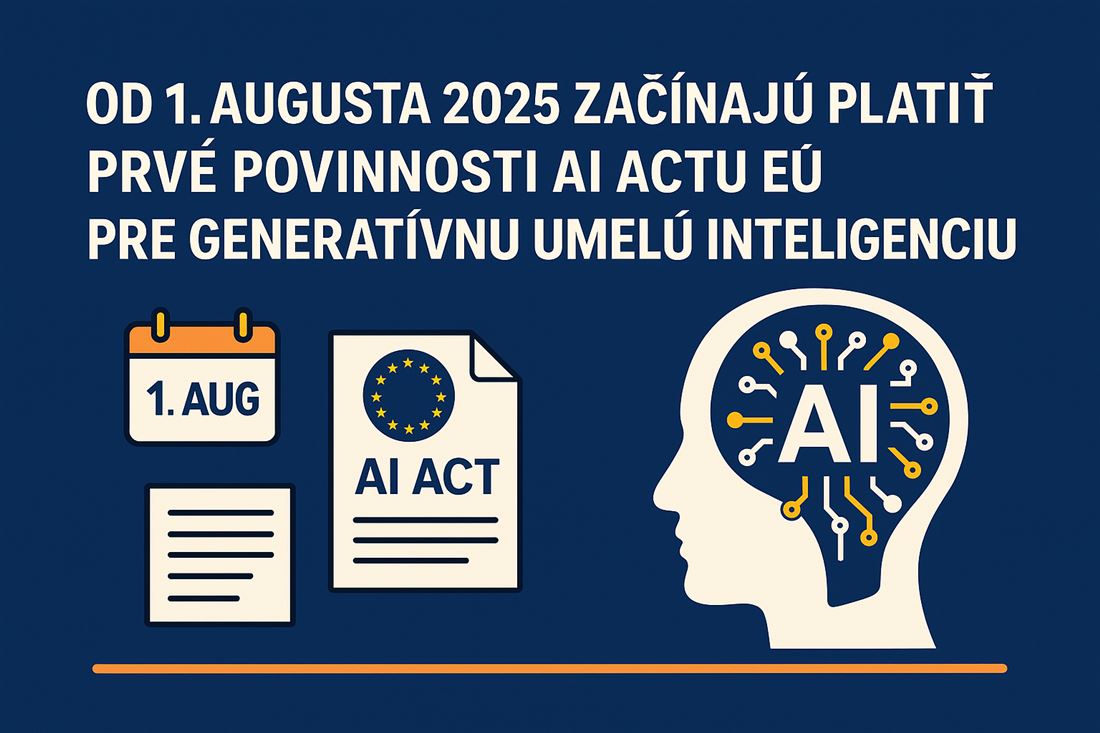
As of August 1, 2025, the first set of rules under the European Union’s AI Act will take effect, covering generative AI models—that is, systems capable of generating text, images, or audio, such as ChatGPT, Midjourney, Claude, or DALL·E.
These new rules focus on greater transparency, copyright protection, and the responsible use of generative models.
Which obligations are coming into effect?
1. Transparency of training data
Providers of generative AI models must disclose information about the sources they used to train their models. This primarily applies to datasets, websites, libraries, and databases. Part of this obligation is also the availability of technical documentation for regulatory authorities and a simplified description for ordinary users.
2. Intellectual Property Protection
Models will be subject to scrutiny regarding copyright compliance. Providers will have to demonstrate that they used legally obtained data or allowed authors to opt out of model training.
3. Documentation for Application Developers
Standardized documentation will be available for those implementing generative AI into their products. This should include information on security risks, model limitations, response accuracy, and incident reporting procedures.
4. Code of Practice
Although it is currently voluntary, many companies have already signed up to it. It is a self-regulatory framework that allows companies to demonstrate responsible use of AI models and compliance with legislation even before stricter measures come into effect in 2027.
5. Launch of the European AI Office
A new AI Office is being established to oversee compliance with the rules, assess risks, and handle complaints. Citizens and companies will be able to file complaints and report incidents via an online form.
What lies ahead?
Date Event
August 1, 2025 Entry into force of rules for generative AI
August 1, 2026 Entry into force of rules for high-risk AI systems
August 1, 2027 Obligations for the most powerful models with so-called “systemic risk”
Which systems are specifically considered high-risk under the AI Act?
Read our colleague’s article on this topic:
What Are High-Risk AI Systems Under the AI Act – Legalfirm.sk
Conclusion
This step by the EU represents a significant milestone in the regulation of artificial intelligence, aimed at protecting consumers and content creators while supporting the trustworthy and responsible development of AI technologies. Although this is only the first phase, in practice it marks the beginning of a new era of regulated AI development in Europe.