A DDoS attack can take a website offline in a matter of minutes. Learn how to identify, analyze, and effectively mitigate it using properly configured infrastructure and security tools.
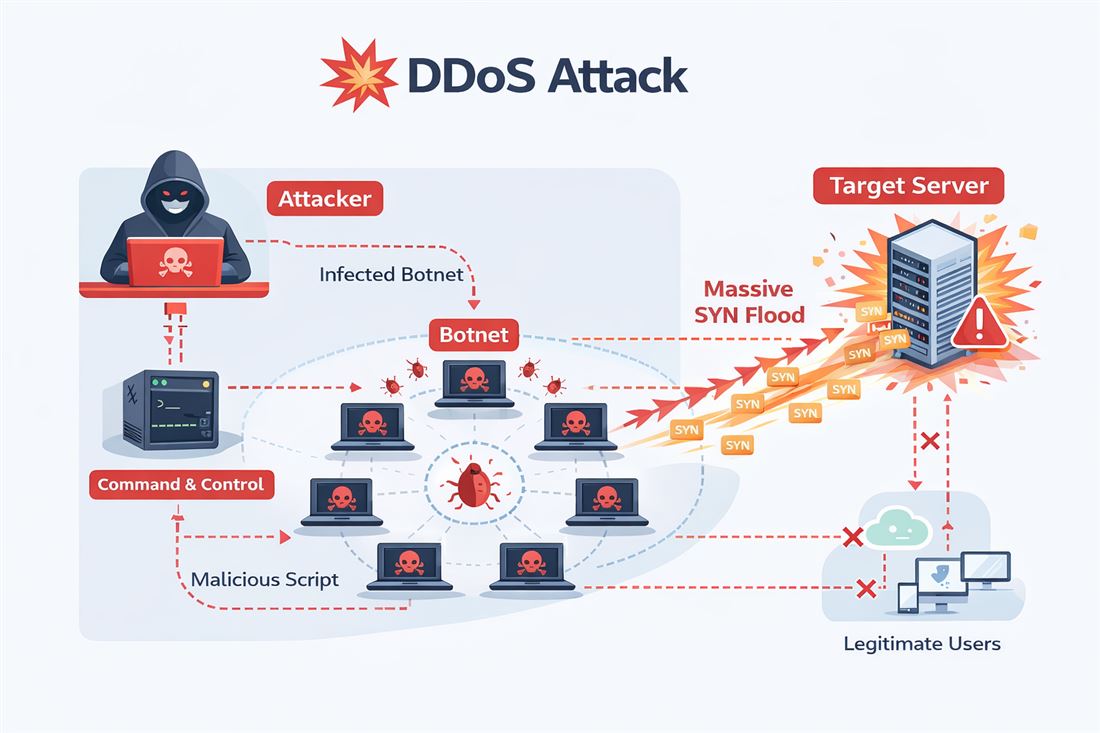
A DDoS attack is primarily a matter of service availability. It does not involve compromising the system in the sense of gaining access or causing a data breach, but rather exhausting resources—most commonly network capacity, CPU, or the application layer—to the point where legitimate users are unable to use the service. Service outages often result in direct revenue loss, unavailability of services for clients, and reputational damage.
In practice, we encounter DDoS attacks in various forms. The simplest are volumetric attacks, which aim to flood the connection with a massive volume of data. More sophisticated attacks target specific protocols or application layers, such as HTTP requests, which appear legitimate at first glance but are actually generated automatically. These attacks are particularly difficult to detect because they masquerade as normal traffic.
A typical real-world example is an e-shop during a marketing campaign or seasonal peak, where increased traffic makes it difficult to distinguish between legitimate users and an attack.
When a service outage occurs, the first step is not to panic, but to analyze the situation. The key is to examine the metrics—particularly a sudden surge in inbound traffic, the number of requests per second, and the behavior of individual endpoints. If we see a disproportionately high number of requests from a single type of endpoint or recurring patterns in requests, this is a strong indicator of an attack. It is equally important to monitor the geographic origin of traffic and the distribution of IP addresses.
At this stage, work with logs and monitoring comes into play. Tools such as SIEM or basic server-level logging allow for the identification of anomalies. A specialist should be able to quickly filter out suspicious traffic, for example, based on IP ranges, user-agents, or request frequency. The goal is not to immediately “stop the attack,” but to understand its nature.
Next comes mitigation. Ideally, the infrastructure is prepared and uses external protective layers, such as Cloudflare or AWS Shield, which can filter out malicious traffic before it reaches the server. If such protection is not available, solutions are implemented directly at the server or firewall level—for example, rate limiting, IP address blocking, or temporarily restricting certain endpoints.
It is important to realize that not every block is effective. In distributed attacks, where traffic comes from thousands of IP addresses, manual blocking is practically ineffective. Therefore, automated mechanisms are used instead, which can identify patterns of behavior and respond in real time.
From a technical perspective, system architecture is also key. Applications that are horizontally scalable and distributed handle DDoS attacks significantly better than monolithic solutions running on a single server. Caching, load balancing, and the separation of individual application layers also help. Security is not just about responding to an incident, but also about proper infrastructure design.
After the incident is contained, the analysis phase begins. It is necessary to identify what enabled the attack, how quickly it was detected, and what the response was. The outcome should be specific measures—such as adjusting firewall rules, improving monitoring, or deploying more advanced protection.
The best protection against a DDoS attack does not arise during the incident, but rather during the design of the infrastructure and the configuration of security measures.
From a practical perspective, a DDoS attack is a very good example of how networking, infrastructure, and security intersect.
