Top Secret, Secret, Confidential, Restricted—what is the difference between these classification levels, and what do they mean for companies applying for an industrial security clearance?
When a company first encounters a requirement from a government agency or a major client stating, “You must have a ‘Confidential’ clearance,” it often has no idea what exactly that means. Slovak legislation, however, regulates the classification of classified information quite strictly, and for entrepreneurs who wish to enter into contracts with the government, the defense industry, or other sensitive sectors, understanding this classification is a fundamental prerequisite for success.
Four Levels, Not Three
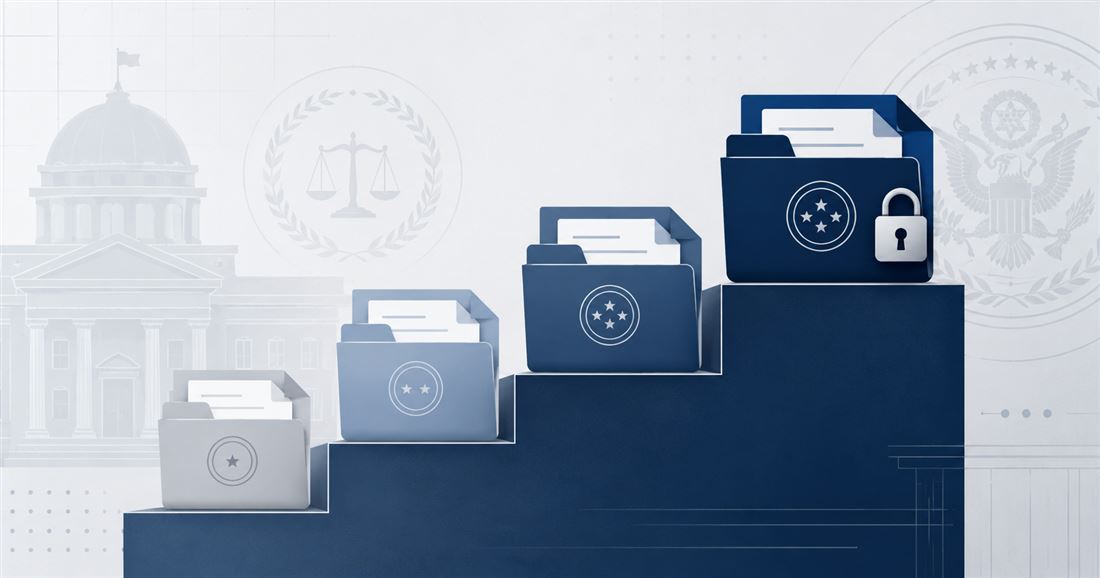
Act No. 215/2004 Coll. on the Protection of Classified Information distinguishes four levels of classification, which are designated by words or abbreviations:
- Top Secret (PT)
- Secret (T)
- Confidential (D)
- Restricted (V)
The difference between them is not merely formal but depends on the extent of harm that would result from unauthorized handling of the information in question:
- Top Secret – information whose disclosure could seriously jeopardize the constitutional order, sovereignty, or territorial integrity of the state, or cause irreparable damage in the areas of defense, security, economic interests, foreign policy, or international relations. The law refers here to “exceptionally serious harm” to the interests of the Slovak Republic.
- Secret – a leak could jeopardize the state’s foreign policy position, defense, security, or economic interests, which represents a lower but still serious level of risk.
- Confidential – unauthorized handling could harm state, public, or legally protected interests of a state authority. The law refers to this as “simple harm.”
- Restricted – the lowest level; a leak could result in harm to the legally protected interests of a legal entity or natural person.
It is important to note that the decision to classify information at a specific level is not made by the company, but by the entity that creates or holds the classified information—typically a government agency. The business thus finds itself in a position where it must adapt its internal processes to the given classification level, not the other way around.
Why This Is Important for Companies, Too
If a company is bidding on a contract that involves access to classified information (e.g., as a government subcontractor, a provider of IT solutions for security agencies, or an entity trading in military equipment), it must first undergo an industrial security clearance and obtain a certificate of industrial security from the National Security Authority (NBÚ) for the relevant classification level.
The classification level also directly determines what type of security clearance the company and its employees must obtain. The law distinguishes between Level I through IV security clearances:
- Level I clearance – applies to the “Restricted” classification level and is conducted by the head of the organization.
- Levels II, III, and IV security clearances—correspond to the levels Confidential, Secret, and Top Secret, respectively, and are conducted directly by the National Security Authority (or, depending on the nature of the position, by the Slovak Information Service, Military Intelligence, or the Police Force).
The higher the classification level a company requires, the more extensive the vetting process will be—ranging from an evaluation of basic supporting documents to an in-depth review of the individual, their family ties, financial circumstances, and integrity. This is also related to the validity period of the issued certificate: five years for the “Top Secret” level, seven years for the “Secret” level, and ten years for the “Confidential” level.
What This Means in Practice
For a business owner, this essentially means three things:
- Even before submitting a bid for a public procurement contract or entering into a contract with a government agency, it is necessary to know what classification level the security clearance will apply to, as this determines both the time required and the administrative burden of the entire process.
- The security clearance applies not only to the company as a whole but also to specific individuals who are to be privy to classified information. The company must therefore determine in advance which employees will undergo the security clearance process.
- In addition to the security clearance of individuals, the entrepreneur must generally also meet physical, administrative, and technical security requirements (for example, in accordance with National Security Authority Decree No. 301/2013 Coll. on industrial security and the business operator’s security plan, which was amended in 2025 by Decree No. 186/2025 Coll.)—that is, to secure its premises, document records, and IT infrastructure to the required standard.
Summary
The distinction between the levels Top Secret, Secret, Confidential, and Restricted is not merely a theoretical classification. It is a practical tool that determines what type of security clearance a company needs, how long it will remain valid, and what security measures it must implement. Companies planning to bid on contracts with the government or the defense sector should therefore clarify this classification before submitting an application. This will help them avoid unnecessary delays and repeated security clearances.
